Showing posts with label Flowers. Show all posts

Tuesday, November 11, 2008

11-11 REMEMBRANCE POPPY 11-11


REMEMBRANCE DAY


Poppies, the symbol of remembrance for fallen soldiers, were very rare in Flanders prior to World War I.
However the anguished earth of Flanders flowed suddenly red with the blood coloured poppy ‘popaver rhoeas’ among the bodies of slain soldiers of World War I .

During the tremendous bombardments of the war the chalk soils of Flanders became very rich in lime from rubble, allowing ‘popaver rhoeas’ to thrive.

Then, when the fields lay quiet and the death and destruction was over, the earth stopped bleeding its red poppies for the dead. The disturbed lime had been quickly absorbed, and so the poppies had disappeared again.

In Flanders Fields the poppies blow
Between the crosses, row on row,
That mark our place; and in the sky
The larks, still bravely singing, fly
Scarce heard amid the guns below.

We are the Dead. Short days ago
We lived, felt dawn, saw sunset glow,
Loved, and were loved, and now we lie
In Flanders fields.

Take up our quarrel with the foe:
To you from failing hands we throw
The torch, be yours to hold it high.
If ye break faith with us who die
We shall not sleep, though poppies grow
In Flanders fields

This poem was written by a Canadian - John McCrae, a doctor and teacher, who served in WW1.

One of McCrae's closest friends was killed in the fighting and buried in a makeshift grave with a simple wooden cross. Wild poppies were already beginning to bloom between the crosses marking the many graves. Unable to help his friend or any of the others who had died, John McCrae gave them a voice through his poem. It was the second last poem he was to write.

One of the things I find endearing about McCrae is that he sent his young nieces and nephews letters supposedly written by his horse Bonfire that he took to war and he signed those letters with a hoof print.

In part because of the poem's popularity, the poppy was adopted as the Flower of Remembrance for the war dead of Britain, France, the United States, Canada and other Commonwealth countries.

The Poppy Pin Designed for
The Royal Canadian Legion
Date: November, 1921

According to the Royal Canadian Legion, “The centre of the Lapel Poppy was originally black but was changed to green more than twenty years ago to represent the green fields of France. In 2002, the centre was changed back to black to reflect the actual colours of the Poppies in Flanders a red flower with a black centre. It is intended that the black centre will remain as the standard for the production of all future Poppy material.”

LEST WE FORGET

"Each November, millions of poppies blossom in Canada. They blossom on the jackets, dresses and hats of nearly half the Canadian population and they have blossomed over 80 years, since 1921. The poppy is the symbol that individuals use to show that they remember those who were killed in the wars and peacekeeping operations that Canada has been involved"

-The Royal Canadian Legion

Saturday, September 27, 2008

The Under Sea Worldness of Chihuly-like Pumpkinery

Cucurbita Female Pumpkin Flower

The strange, fluid, other-worldliness of the pumpkin patch looks far more like it belongs under the sea than under my kitchen window

Sea Anemone or Landlubber Flower?

The flowing openess of the flowers. The languid look of the large petals. The coiling tendrils. It is all very, very fluid.

Ready to Swirl and Sway In the Ocean?

These are more like plants I would see on a scuba dive - ready to swirl and sway in an ocean current - than plants exposed on a dry, rocky outcrop.

No Elvis Here, Just Ringo

Some people see Elvis; others see fractals; I see sea anemones. The garden sets off free association imagery like dominoes knocking one image down against another image of experiences and pop culture, (and now add to it blogs,) in my head. In the days of hodden grey, the church and nature provided imagery stimulus so folks saw the Madonna in the tree bark. Nowadays of mass media culture people see Elvis in a gherkin or an Octopus's garden in a pumpkin patch.

...Or , how about Chihuly...

Picture of Chihuly's Persians - Photo credit unknown

Dale Chihuly is an artist whose glass sculptures - the Persians series - drift through the other-world of my pumpkin crevasse. No, I haven't eaten Datura, but I have blown glass .

Pumpkin Visions Come From My Blowing Glass...Not From My Eating Datura

Every time I look at the pumpkins I am stunned with images of Chihuly's Persians I have seen in Victoria, Seattle, Las Vegas, galleries and museums. See fer yerself - thar ain't no denyin' it...


Picture Credit: PERSIAN POND"CHIHULY IN THE PARK: A GARDEN OF GLASS" NOVEMBER 23, 2001 - NOVEMBER 4, 2002GARFIELD PARK CONSERVATORY, CHICAGO
www.chihuly.com


Godly Gourd - The Good Pumpkin - Served At The First Thanksgiving
Canada we have Thanksgiving in October Whilst Our American Neighbours in November

The Garden Brae pumpkin patch is actually more of a pumpkin crevasse. Pumpkins need a sunny, well-drained site. I planted mine in a crevasse on a hot, rocky outcrop and left them to fend for themselves. Nope, I didn't get involved in their sex life either. I left the male and female flowers to co-mingle with whatever bee - go- betweens that happened upon them.


And yet, with this neglect, they still graciously rewarded me with the beauty of their special world! Because of their location up on the rock and the sun shining through them I had a wonderful vantage of being below them looking up into their pumpkin realm, almost like I was floating through them. I feel kinda guilty though ....

Terry and Lisa (my sisters) Portraits in Pumpkin

The pumpkin abuse isn't over yet...in a couple of weeks they will go under the knife for pies and for my pumpkin art!

* * *
Genius Loci thought: Pumpkins are kin to the spirit of the place. They thrived against the odds and settled in to the natural beauty of the landscape. Next year they get care, attention, and a wee bit of coaxing in their sex life.

Friday, September 26, 2008

Infamous Datura: The Plant of Zombies and Angels


Solanaceae
Datura metel

Fragrant, beautiful and deadly the Datura sits in a pot on my porch. I don't trust it. I am suspicious about a plant known as Devil's Trumpet or Zombie Cucumber. Then again, would garden nurseries sell it if it really is the magic potion of evil it is trumpeted to be?

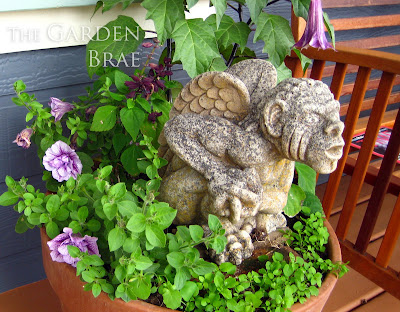
Datura in a pot with a gargoyle statue
Datura sits in a pot on my porch. I don't trust it.


datura in a pot with a gargoyle
Datura also known as Angels Trumpet

A waft of my Datura's fragrance is both beautiful and disgusting. Sometimes I like its heavy, mysterious scent hanging in the air. Other times I find the scent cloying, smothering and nauseating.


Datura also known as Thorn Apple

True, the Datura is beautiful with its unusual "thorn apple" fruits and its trumpet flowers of swirls and ruffles. But, frankly, I am often repulsed by its morbid weirdness and avoid looking at it.


The Sinister History of The Datura


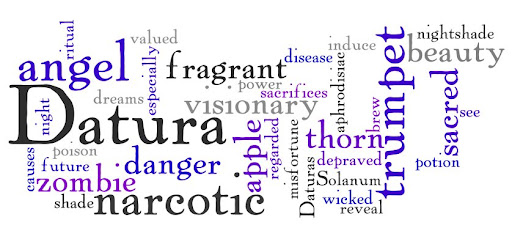
The history of the Datura as
deadly narcotic,
aphrodisiac,
zombie food,
shaman's potion,
witches brew,
are well documented.

One of its many common names,
Jimson weed
is because of its recorded crazy effect
on British soldiers in Jamestown, Virginia in 1676.

A plant that can both compel and repel me - very interesting - gotta love it. But I still don't trust it. So the Datura sits on the porch in a pot guarded by a gargoyle where I can keep my eye on it.


Solanaceae Datura metel - BEWARE

Tuesday, September 23, 2008

Ghostly Ménage à Trois

ghost plant
Ghost Plant Monotropa uniflora

Ghosts! White, translucent, fleshy, and covered with scales nodding in a spooky little group under a tree. It has been 15 years since I saw my last apparition of these plants. What a surprise and rare delight to find these haunting the Garden Brae. Who knows when I will get a chance to write about them again?

What I learned from a Ménage à trois with Ghost Plants :

Forest trees depend on a symbiotic relationship with the fungi at their feet
  • Forest trees are like a sugar daddy to fungus by providing carbohydrates to the fungus
  • Fungus in turn give a little TLC to trees in the form of N-P-K and H2O by providing nutrients and water to the trees
Enter in to this happy relationship the usurping pretty little Monotropa uniflora
  • Monotropa uniflora insinuates itself into the intimate relationship of the forest tree and fungus
  • The ghostly little flower sneaks sugar from the tree intended for the fungus and filches nutrients and water from the fungus intended for the tree.
close up of ghost plant

Current belief is that Monotropa uniflora is a selfish partner and gives nothing in return to tree or fungus in this relationship - that is what makes Monotropa a parasitic plant.

Whereas, it was once thought that Monotropa was saprophytic which fed on dead or decaying vegetation. (Is there a test at the end of this, or what?)

What is the relationship of the tree and fungus you ask?
- Why, it is a mutualistic symbiotic association, ofcourse! - because both tree and fungus gain mutual benefit from each other.

This fascinating plant is the subject of intense study lately to discover its potent hormonal system that sucks sugars away from fungus for its own successful survival.

* * *
Genius Loci thought: Is my relationship to my garden parasitic, saprophytic or mutualistic?

Wednesday, September 17, 2008

Photographing Ghosts In The Garden


ghost plant grouping also known as monotropa translucent little flower with glow of sunset orange on it
Monotropa uniflora

Photographing Ghosts in the Garden is creepy if you consider the subject in the lens is found only in dark woodlands and is known by such morbid names as:
Convulsion Root
Corpse plant
Death plant
Fairy smoke
Ghost flower
Here, on the Island, we mostly call it Indian Pipe (in reference to its pipe-like shape). And far from creepy, I find it a fascinating and cheeky little plant whose ménage à trois existence between trees, fungus and itself is more than a a little beguiling. A botanist's description of the plant as "a waxy white saprophyte of deep forest shade" is ooooh so hauntingly lovely! It evokes a film noir femme fatale as spoken by a hard boiled detective like Bogie or Mitchum as Marlowe...
"... she 'was a waxy white saprophyte of deep forest shade' that haunted the mind of every man in the room. She was a flower alright, a ghost flower, and that spelled corpse plant to the man who did her wrong. And that ain't no fairy smoke to a tough gumshoe like me."

Tuesday, June 10, 2008

It's A Question of Beauty

Slug - My Garden

If you truly love Nature, you will find beauty everywhere- Vincent Van Gogh

Calypso Orchid - Mill Hill

There is no excellent beauty that hath not some strangeness in the proportion.
- Francis Bacon

Trillium - Mill Hill


Apple Blossom - Glendale Gardens

Beauty is not caused. It is.

- Emily Dickinson

Monday, June 9, 2008

The Good, The Bad And the Novelty


The Good, The Bad And the Novelty


Some may think frilly tulips are gilding the lily at best
or in bad taste at worst

These frilly tulips conjure up images of toasted coconut on sickly sweet coconut cream pies


bringing a little kid-like joy and playful fun into the garden

Here is a gaping maw tulip that would scare me away if I was a bee!

It immediately reminded me of Star Trek (original series [of course]) the Doomsday Machine Episode. What do you think- can you see it? There is beauty in flowers that are blown; past their prime; on the verge of finished. But in this case, aside from the brilliant colour combinations, it was again how it brought a smile about scaring bees, and Star Trek episodes that made it beautiful.


Nov
elty is an essential attribute of the beautiful
- Benjamin Disraeli


Novelty is beautiful? Or is Ben saying the beautiful are novel and as the novelty wears off so does their beauty? Would impulse planting of these tulips soon result in regret as the novelty wore off? They arrive in early spring when we are in need of some cheer from the winter gloom. Tulips are gone soon having stood up cheerily to stormy spring gusts. So I think the smiles they bring won't wear off over the years, but would be enjoyed like a friend who often tells the same joke you know its coming and that expectation is what tickles you.

Wednesday, June 4, 2008

Gossamer and a Llama in the Larkspur

GOSSAMER


Weeding got too warm today so we wandered up the hill just beyond our little Garden Brae


Oberon lay down in the meadow in an area flattened by deer


The crazy ultra blue of the larkspur (delphiniums) was almost unnatural


I lay down inside a moss covered crevice under a canopy thick with the gossamer of webs


and lazily watched a spider


When out of the corner of my eye I spied the half of a "Push-Me-Pull-You"!


I jumped up carefully so as not to get a face full of spider webs and disrupt that little insect palace


Lo and behold I hadn't gone bonkers
There it was - a very real Llama coming down the hill

No, it wasn't a double headed pushmi-pullyu with the very British Dr. Dolittle in tow.
Instead, it was a sweet Llama from the Millstream Llama Farm Bed & Breakfast with the very charming British proprietress in tow.

You just never know what's around the corner