Showing posts with label Art. Show all posts

Tuesday, November 11, 2008

11-11 REMEMBRANCE POPPY 11-11


REMEMBRANCE DAY


Poppies, the symbol of remembrance for fallen soldiers, were very rare in Flanders prior to World War I.
However the anguished earth of Flanders flowed suddenly red with the blood coloured poppy ‘popaver rhoeas’ among the bodies of slain soldiers of World War I .

During the tremendous bombardments of the war the chalk soils of Flanders became very rich in lime from rubble, allowing ‘popaver rhoeas’ to thrive.

Then, when the fields lay quiet and the death and destruction was over, the earth stopped bleeding its red poppies for the dead. The disturbed lime had been quickly absorbed, and so the poppies had disappeared again.

In Flanders Fields the poppies blow
Between the crosses, row on row,
That mark our place; and in the sky
The larks, still bravely singing, fly
Scarce heard amid the guns below.

We are the Dead. Short days ago
We lived, felt dawn, saw sunset glow,
Loved, and were loved, and now we lie
In Flanders fields.

Take up our quarrel with the foe:
To you from failing hands we throw
The torch, be yours to hold it high.
If ye break faith with us who die
We shall not sleep, though poppies grow
In Flanders fields

This poem was written by a Canadian - John McCrae, a doctor and teacher, who served in WW1.

One of McCrae's closest friends was killed in the fighting and buried in a makeshift grave with a simple wooden cross. Wild poppies were already beginning to bloom between the crosses marking the many graves. Unable to help his friend or any of the others who had died, John McCrae gave them a voice through his poem. It was the second last poem he was to write.

One of the things I find endearing about McCrae is that he sent his young nieces and nephews letters supposedly written by his horse Bonfire that he took to war and he signed those letters with a hoof print.

In part because of the poem's popularity, the poppy was adopted as the Flower of Remembrance for the war dead of Britain, France, the United States, Canada and other Commonwealth countries.

The Poppy Pin Designed for
The Royal Canadian Legion
Date: November, 1921

According to the Royal Canadian Legion, “The centre of the Lapel Poppy was originally black but was changed to green more than twenty years ago to represent the green fields of France. In 2002, the centre was changed back to black to reflect the actual colours of the Poppies in Flanders a red flower with a black centre. It is intended that the black centre will remain as the standard for the production of all future Poppy material.”

LEST WE FORGET

"Each November, millions of poppies blossom in Canada. They blossom on the jackets, dresses and hats of nearly half the Canadian population and they have blossomed over 80 years, since 1921. The poppy is the symbol that individuals use to show that they remember those who were killed in the wars and peacekeeping operations that Canada has been involved"

-The Royal Canadian Legion

Saturday, September 27, 2008

The Under Sea Worldness of Chihuly-like Pumpkinery

Cucurbita Female Pumpkin Flower

The strange, fluid, other-worldliness of the pumpkin patch looks far more like it belongs under the sea than under my kitchen window

Sea Anemone or Landlubber Flower?

The flowing openess of the flowers. The languid look of the large petals. The coiling tendrils. It is all very, very fluid.

Ready to Swirl and Sway In the Ocean?

These are more like plants I would see on a scuba dive - ready to swirl and sway in an ocean current - than plants exposed on a dry, rocky outcrop.

No Elvis Here, Just Ringo

Some people see Elvis; others see fractals; I see sea anemones. The garden sets off free association imagery like dominoes knocking one image down against another image of experiences and pop culture, (and now add to it blogs,) in my head. In the days of hodden grey, the church and nature provided imagery stimulus so folks saw the Madonna in the tree bark. Nowadays of mass media culture people see Elvis in a gherkin or an Octopus's garden in a pumpkin patch.

...Or , how about Chihuly...

Picture of Chihuly's Persians - Photo credit unknown

Dale Chihuly is an artist whose glass sculptures - the Persians series - drift through the other-world of my pumpkin crevasse. No, I haven't eaten Datura, but I have blown glass .

Pumpkin Visions Come From My Blowing Glass...Not From My Eating Datura

Every time I look at the pumpkins I am stunned with images of Chihuly's Persians I have seen in Victoria, Seattle, Las Vegas, galleries and museums. See fer yerself - thar ain't no denyin' it...


Picture Credit: PERSIAN POND"CHIHULY IN THE PARK: A GARDEN OF GLASS" NOVEMBER 23, 2001 - NOVEMBER 4, 2002GARFIELD PARK CONSERVATORY, CHICAGO
www.chihuly.com


Godly Gourd - The Good Pumpkin - Served At The First Thanksgiving
Canada we have Thanksgiving in October Whilst Our American Neighbours in November

The Garden Brae pumpkin patch is actually more of a pumpkin crevasse. Pumpkins need a sunny, well-drained site. I planted mine in a crevasse on a hot, rocky outcrop and left them to fend for themselves. Nope, I didn't get involved in their sex life either. I left the male and female flowers to co-mingle with whatever bee - go- betweens that happened upon them.


And yet, with this neglect, they still graciously rewarded me with the beauty of their special world! Because of their location up on the rock and the sun shining through them I had a wonderful vantage of being below them looking up into their pumpkin realm, almost like I was floating through them. I feel kinda guilty though ....

Terry and Lisa (my sisters) Portraits in Pumpkin

The pumpkin abuse isn't over yet...in a couple of weeks they will go under the knife for pies and for my pumpkin art!

* * *
Genius Loci thought: Pumpkins are kin to the spirit of the place. They thrived against the odds and settled in to the natural beauty of the landscape. Next year they get care, attention, and a wee bit of coaxing in their sex life.

Sunday, June 22, 2008

The Mighty Saskatoon - Notorious & Nutritious


Kwakwaka’wakw Pole Carvings
Carver: Tony Hunt


Native Plant Wisdom
The Saskatoon Berry (Amelanchier alnifolia)

First Nations People identified 9 varieties based on taste, growth times, seediness, size and colour.

The varieties were dried like raisins for winter eating, cooked to the consistency of jam, made into juices for marinade to sweeten roots and foods like black tree lichen, and, ofcourse, eaten fresh.

Saskatoon Berry Bush was used as medicine by steeping the twigs and stems to be given to women after childbirth and as a healing bath. Tonics were made to cure stomach ailments. Juice used to settle upset stomachs and used as ear drops.

The Saskatoon berry was the most used berry of the First Nations coastal and interior peoples. It was often used as a trade item. The hardwood was used to make combs, firedrills, arrows, tool handles, salmon spreaders, and fishnet reinforcements


Saskatoon Berry in flower at the Garden Brae
Saskatoon (Amelanchier alnifolia)
AKA: Serviceberry, Juneberry, Amelanchier (French) and Shadbush

Resembles a wild blueberry
(I don't have photo of the berry in my garden-yet)
Tastes like a blueberry and cherry with a hint of almond - Yummy!
Super Food! Super Healthy! The Super Saskatoon!
Better than blueberries for nutrients and antioxidants!!!

The Notorious & Nutritious - The Saskatoon

The Scandalous Saskatoon! Notorious International Scandal In June 2004, Britain banned Saskatoon berry products off its shelves over concerns about the safety of the berries since there was no history of people in Europe eating them

It has been all dog and no blog for a while...

Oberon broke her leg and had metal plate/pin orthopaedic surgery and is doing very well. Full speedy recovery expected.(Her people parents are recovering from the shock of seeing her hurt, too, but not as speedy!)
To make up for lack of posts, here are some of the fascinating Totem Poles which we are privileged to live with as one of the many special and unique qualities of living in the Pacific Northwest.


Royal British Columbia Museum

I took these pics at Thunderbird Park

Thunderbird is traditionally carved
with outstretched wings, curved horns and a face in its chest.

Totem Poles

The figures on totem poles are crests that proclaim
ancestry, history, rights and privileges, names,
lands and responsibilities of the families that own them.
Types of Totem Poles include:
House Post hold up the main roof beams of the big house
Frontal Poles stand against the front of the house and usually contain the house’s doorway
Memorial Poles are raised in honour of the deceased and are usually commissioned by the person who inherited the dead person's name/privileges.
Mortuary Poles incorporated boxes of the person's remains
Welcome Figures greet visitors to a chief’s territory and traditionally stood on the beach facing out to sea so they could welcome people
who arrived by canoe


Saturday, May 10, 2008

Ornamental Hermit for the 21st Century


A Hermit on "my" Hill? Sure, it would be great. He, or why not she, would have wireless Internet for their laptop and would also be kitted out with the latest and greatest camp gear from Canadian Tire. I mean, after all, workers' rights have improved a bit since the 18Th century. The Hermit could eat up some of the destructive invasive alien introduced critters that overrun the place - grey squirrels, eastern cotton tailed rabbits and American bullfrogs. And after eating hearty eliminating alien meals, the Hermit can get to work at the endless task of pulling broom (Cytisus scoparius). I hate that stuff and pull it every chance I get - about 20 a week - following a broom pull strategy. I dislike broom so much I won't even show a picture of it.
Would my Hermit be territorial? Would I be bailing him/her out of jail for warring in barroom brawls with the Skirt Mountain (AKA Bare (Bear) Mountain) Hermit? Well I am sure it would only occur every payday when Hermits gets tippled at one of the local pubs in the area. And since Hermit paydays are once every 5 years, I don't expect this to be a big problem.

http://www.hermitary.com/faqs.html

So, yes, a Hermit for my Garden Brae it is. Some nice, old, wisdomful ancient who talks to the wind in the forest, who is a wizard with a dowser for divining water (sure to come in handy with global warming on its way here) and who would dine on rabbit and deer to keep them from feasting on my flowers.

What has this all to do with Genius Loci in my garden design? Blogging it down is like keeping a journal on the discoveries and thoughts about what it is like to live here. The conclusions that emerge from the blogging will hopefully reveal the Genius Loci.

Friday, May 9, 2008

Sins of A Gardener

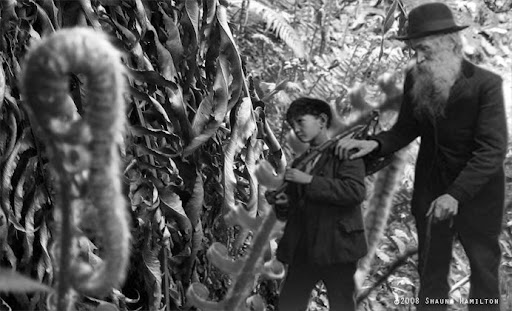
[Postcard Art montage of my garden ferns and a hobo knowingly touching his nose with caption here be hermits done in 1970 style]
Hermits Wanted
Do People Piss You Off?
Want To Get Away From It All?
Like to Read - A Lot?

Then we have a job for you!

Hermits wanted for ornamentation of gentleman's estate. You must never be seen. If you have to poke your head out of your grotto/cave home, it better have a long, long beard on it and be stroked by your long, long fingernails. You will be paid a small fortune, but not until you complete 5 years of service as a garden ancient - an ornamental hermit . If you don't last the five years you forfeit all earnings.

Yes, it was quite the fad in the 18th century to have a live ornamental hermit installed in your garden estate. The most famous employer of one of these decorative solitudinarians was Charles Hamilton. (Hmmm I wonder if good old Chuck is sitting in my family tree somewhere?)