Showing posts with label Plant Lore. Show all posts

Tuesday, November 11, 2008

11-11 REMEMBRANCE POPPY 11-11


REMEMBRANCE DAY


Poppies, the symbol of remembrance for fallen soldiers, were very rare in Flanders prior to World War I.
However the anguished earth of Flanders flowed suddenly red with the blood coloured poppy ‘popaver rhoeas’ among the bodies of slain soldiers of World War I .

During the tremendous bombardments of the war the chalk soils of Flanders became very rich in lime from rubble, allowing ‘popaver rhoeas’ to thrive.

Then, when the fields lay quiet and the death and destruction was over, the earth stopped bleeding its red poppies for the dead. The disturbed lime had been quickly absorbed, and so the poppies had disappeared again.

In Flanders Fields the poppies blow
Between the crosses, row on row,
That mark our place; and in the sky
The larks, still bravely singing, fly
Scarce heard amid the guns below.

We are the Dead. Short days ago
We lived, felt dawn, saw sunset glow,
Loved, and were loved, and now we lie
In Flanders fields.

Take up our quarrel with the foe:
To you from failing hands we throw
The torch, be yours to hold it high.
If ye break faith with us who die
We shall not sleep, though poppies grow
In Flanders fields

This poem was written by a Canadian - John McCrae, a doctor and teacher, who served in WW1.

One of McCrae's closest friends was killed in the fighting and buried in a makeshift grave with a simple wooden cross. Wild poppies were already beginning to bloom between the crosses marking the many graves. Unable to help his friend or any of the others who had died, John McCrae gave them a voice through his poem. It was the second last poem he was to write.

One of the things I find endearing about McCrae is that he sent his young nieces and nephews letters supposedly written by his horse Bonfire that he took to war and he signed those letters with a hoof print.

In part because of the poem's popularity, the poppy was adopted as the Flower of Remembrance for the war dead of Britain, France, the United States, Canada and other Commonwealth countries.

The Poppy Pin Designed for
The Royal Canadian Legion
Date: November, 1921

According to the Royal Canadian Legion, “The centre of the Lapel Poppy was originally black but was changed to green more than twenty years ago to represent the green fields of France. In 2002, the centre was changed back to black to reflect the actual colours of the Poppies in Flanders a red flower with a black centre. It is intended that the black centre will remain as the standard for the production of all future Poppy material.”

LEST WE FORGET

"Each November, millions of poppies blossom in Canada. They blossom on the jackets, dresses and hats of nearly half the Canadian population and they have blossomed over 80 years, since 1921. The poppy is the symbol that individuals use to show that they remember those who were killed in the wars and peacekeeping operations that Canada has been involved"

-The Royal Canadian Legion

Friday, September 26, 2008

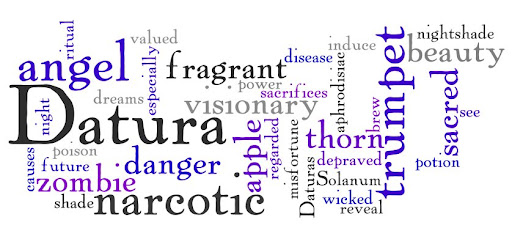
Infamous Datura: The Plant of Zombies and Angels


Solanaceae
Datura metel

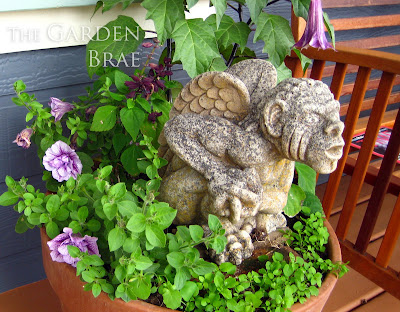
Fragrant, beautiful and deadly the Datura sits in a pot on my porch. I don't trust it. I am suspicious about a plant known as Devil's Trumpet or Zombie Cucumber. Then again, would garden nurseries sell it if it really is the magic potion of evil it is trumpeted to be?

Datura in a pot with a gargoyle statue
Datura sits in a pot on my porch. I don't trust it.


datura in a pot with a gargoyle
Datura also known as Angels Trumpet

A waft of my Datura's fragrance is both beautiful and disgusting. Sometimes I like its heavy, mysterious scent hanging in the air. Other times I find the scent cloying, smothering and nauseating.


Datura also known as Thorn Apple

True, the Datura is beautiful with its unusual "thorn apple" fruits and its trumpet flowers of swirls and ruffles. But, frankly, I am often repulsed by its morbid weirdness and avoid looking at it.


The Sinister History of The Datura


The history of the Datura as
deadly narcotic,
aphrodisiac,
zombie food,
shaman's potion,
witches brew,
are well documented.

One of its many common names,
Jimson weed
is because of its recorded crazy effect
on British soldiers in Jamestown, Virginia in 1676.

A plant that can both compel and repel me - very interesting - gotta love it. But I still don't trust it. So the Datura sits on the porch in a pot guarded by a gargoyle where I can keep my eye on it.


Solanaceae Datura metel - BEWARE

Wednesday, September 17, 2008

Photographing Ghosts In The Garden


ghost plant grouping also known as monotropa translucent little flower with glow of sunset orange on it
Monotropa uniflora

Photographing Ghosts in the Garden is creepy if you consider the subject in the lens is found only in dark woodlands and is known by such morbid names as:
Convulsion Root
Corpse plant
Death plant
Fairy smoke
Ghost flower
Here, on the Island, we mostly call it Indian Pipe (in reference to its pipe-like shape). And far from creepy, I find it a fascinating and cheeky little plant whose ménage à trois existence between trees, fungus and itself is more than a a little beguiling. A botanist's description of the plant as "a waxy white saprophyte of deep forest shade" is ooooh so hauntingly lovely! It evokes a film noir femme fatale as spoken by a hard boiled detective like Bogie or Mitchum as Marlowe...
"... she 'was a waxy white saprophyte of deep forest shade' that haunted the mind of every man in the room. She was a flower alright, a ghost flower, and that spelled corpse plant to the man who did her wrong. And that ain't no fairy smoke to a tough gumshoe like me."

Monday, May 26, 2008

In Bloom Today In The Garden Brae

In Bloom Today In The Garden Brae - Lilacs

Come and smell the lilacs with Oberon

Syringa (Lilacs)
Syringa stems (pun intended) from the Greek word 'syrinx' meaning tube or hollow pipe

Greek legend has it that a nymph named Syrinx was chased by the god Pan
Naughty Pan turned Syrinx into a reed from which he made his very first flute (Pan-pipes)
Lilacs are a very hardy ornamental woody shrub
with colourful, fragrant flowers that bloom here in the merry month of May
Are lilacs old fashioned? Maybe. I love them because my mom loved them for their fragrance. They reminded her of her childhood in Dublin, Ireland.
There was a house down the street from me as a child that had rows of lilacs over flowing along a picket fence onto the sidewalk. My mom would take my hand to cross the street just to walk by them and smell them on the way to the bus stop.
I was young but I could tell she was homesick for Eire

It was the 60's in Victoria and lots of moms took buses and walked instead of driving...
but I digress.
Fragrance does that to you - it triggers memories

Thanks for walking through the lilacs at the Garden Brae with me.


Tuesday, May 13, 2008

Symbolism of Ferns

The fern in Christian iconography is a symbol of the life and humility of the hermit because ferns live in shaded, half-hidden locations

The fern is also associated with magic, fascination, confidence, shelter, discretion, reverie and a secret bond of love.

Here are more pictures of ferns from in and around the Garden Brae